Tractor Season Is Here!

(Updated: May 2, 2024, 6:15 a.m.)
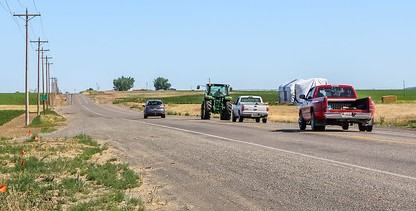
Cars riding behind a tractor on a road.

Tractor Season

It is planting season for many farmers in Surry County. Beginning now through harvest, we will find ourselves sharing the road with farm vehicles, tractors, sprayers, harvesters, and other types of oversized agricultural equipment. Farm vehicles are slower and many times wider than our cars and trucks. This makes them more challenging to maneuver quickly. It also makes it harder to move off the road without hitting mailboxes.

Farm vehicles are operated by people who are responsible for growing the food we eat, the clothes we wear, and the materials we use in our homes and businesses every single day. Let’s make sure that we all arrive to our destinations safely with a few best practices in roadway safety.

*Keep an eye out for slow-moving vehicle (SMV) signs

*Slow down when agricultural equipment enters the roadway

*Be aware that farm vehicles have major blind spots directly in front, behind, and other places around the farm vehicle depending on the equipment type and attached implements

* Be conscientious of the size of farm vehicles and the space that is needed to maneuver the equipment on roadways

*Maintain a two-car-length distance away from farm vehicles

*Be cautious of agricultural equipment making wide left turns

*Allow extra travel time if traveling through an agricultural area

 

Facts About Tractor Safety on the Road

By Farm Bureau of North Carolina
Farm Bureau

  • From 2015-2019, there were more than 1,000 accidents on North Carolina roads involving farm vehicles, tractors, and equipment – that’s more than 200 every year.
  • During that time, the top five North Carolina counties for farm vehicle accidents were Wake (40), Guilford (33), Johnston (33), Sampson (33), and Wayne (33).
  • Studies have found that 82% of farm equipment crashes involve a non-farm vehicle.
  • Fatalities are FIVE TIMES more likely in accidents involving farm vehicles.
  • Many farm vehicles travel less than twenty-five miles per hour. A car traveling sixty-five miles per hour would close a gap the size of a football field in less than five seconds.
  • Rural roads carry less than half of America’s traffic, yet they account for over half of the nation’s vehicular deaths.
  • A car traveling at 70 miles per hour requires almost 400 feet of total stopping distance, and about 750 feet in wet conditions. That’s why it’s important for drivers to stay alert to improve reaction time.
  • Reacting just one second earlier reduces your stopping distance by more than 100 feet when traveling at 70 miles per hour. That’s more than the length of a basketball court.
  • Left turns are especially dangerous for farm vehicles – in fact the most common types of collisions involving farm vehicles are side swipes and angle crashes. These types of crashes typically occur while farm equipment is turning left, and another vehicle attempts to pass.
  • Many farm vehicles make wide left turns, which makes it look like they are turning right or pulling off to allow following cars to pass. Do not make this mistake! Never pass a farm vehicle unless you are absolutely certain it is safe and legal to do so.
  • Many tractor operators will signal a left-hand turn by hand, which may look like an invitation to pass. Bottom line: never pass farm vehicles in a no-passing zone.
  • Tractor operators need to know you are there – for your safety and for theirs. If you follow too closely, they can’t see you. So let them know you are there by staying back at least two car lengths.
  • We get it. Driving 20 miles per hour isn’t ideal. But reducing your speed from 65 to 20 miles per hour for one mile only delays you about 2 minutes!